

In the long river of world cultural exchange, Chinese guqin art, as a treasure of Eastern culture, carries the core connotation of the Confucian ideal of “moderation and harmony” (zhonghe). Its pure tones and elegant resonance crossed mountains and seas, and in Japan—deeply imbued with Confucian culture—it completed the full journey from cultural introduction to local integration. This process was not merely the dissemination of an instrument and its musical forms, but also an extension and reinterpretation of the Confucian value that “music connects with ethics” in a foreign land, adding a brilliant chapter to the artistic exchange within the East Asian cultural sphere.
I. The Eastward Transmission of the Guqin: Historical Threads and Evidenced by Physical Documents
The binding of the Chinese guqin with Confucian culture had already taken shape as early as the pre-Qin period. The Book of Rites·Record of Music (Liji·Yueji) states: “Music is that which connects with ethics.” The guqin’s pursuit of moderation, balance, clarity, subtlety, and tranquility is precisely the concrete embodiment of the Confucian philosophy of the “Doctrine of the Mean” (zhongyong) in the realm of music. This art form, imbued with such cultural essence, formally embarked on its journey eastward to Japan during the peak of East Asian cultural exchange in the Tang dynasty.
(I) The Nara Period: Official Introduction and Early Court Flourishing
The definitive point at which the guqin was introduced to Japan can be traced back to the Nara period (710–794 CE). At that time, Japan dispatched multiple missions of kentōshi (envoys to Tang China) to comprehensively study Tang culture. The guqin, as a representative of courtly elegant music (yayue), entered Japanese upper-class society along with institutional systems and classical texts. The material remains from this period stand as the most direct testimony to this history:
· The Gold-and-Silver Inlaid Lacquer Qin in the Shōsōin: This Tang-dynasty guqin, now housed in the Shōsōin repository in Nara, features exquisite gold-and-silver decorative patterns on its body. Its form is consistent with that of Tang court qin, making it a premier cultural artifact of Sino-Japanese exchange during the kentōshi era, and confirming the official introduction of the guqin as a “cultural token.”
· The Kaiyuan 12th-Year Qin at Hōryū-ji: This guqin, inscribed with “Made in Jiulong County, the 12th year of Kaiyuan” (724 CE) on its belly and preserved at Hōryū-ji in Nara, bears a clear date. Its craftsmanship closely matches that of contemporary qin made in the Shu region (present-day Sichuan) of China, further substantiating the transmission of Tang-dynasty qin to Japan through official channels.
In addition to physical artifacts, documentary records are also abundant. During the reign of Emperor Uda (corresponding to the late Tang dynasty), the scholar Sae no Masafusa compiled the Catalogue of Books Existing in Japan (Nihonkoku Genzaisho Mokuroku). Under the category of “Music” (Gakka), it lists 11 works on qin in 23 volumes, including the Qincao (Qin Scores), Qinpu (Qin Tablature), and Qinji (Qin Collections)—a number comparable to the qin literature recorded in the Sui-shu·Jingjizhi (Book of Sui·Treatise on Classics) and the Jiu Tang-shu·Jingjizhi (Old Book of Tang·Treatise on Classics). This demonstrates that Japan, while importing the physical instrument, simultaneously absorbed the theoretical framework of qin studies, thereby laying a documentary foundation for its subsequent development.
(II) The Heian Period: Preliminary Infiltration from the Court to the Literati
Entering the Heian period (794–1192 CE), the transmission of the guqin extended from the court to the literati class. With the rise of Japan’s “national culture” (kokufū bunka), the guqin was no longer viewed merely as a “Tang object” (karamono) but began to integrate preliminarily with indigenous cultural elements:
· Literati combined the guqin with waka poetry composition. For example, Ki no Tsurayuki, compiler of the Kokin Wakashū (Collection of Ancient and Modern Japanese Poetry), mentioned in his diary “playing the qin and composing waka,” using the melody of the guqin to set the rhythm of waka, giving rise to an aesthetic model of “symbiosis of qin and song”;
· Court nobles, during activities such as miyū (imperial excursions) and gashū (elegant gatherings), placed guqin performance alongside tea ceremony and flower arrangement, endowing it with new connotations as a “symbol of refined living.” This transformation laid the groundwork for the guqin to shed its label of “foreign culture” and become embedded in Japanese society.
II. Deep Cultivation of Localization: Integrated Innovation from Technique to Theory
The true rooting of the guqin in Japan began with the “selective inheritance” of Chinese traditions and their “localized transformation.” This process reached its peak in the Edo period, with the eastward journey of the Chan master Donggao Xinyue (Tōkō Shin’etsu) as a pivotal turning point, giving rise to a qin studies system that combined Chinese traditional genes with distinctive Japanese cultural characteristics.
(I) The Edo Period: Donggao Xinyue and the Founding of the “Donggao Qin School”
In the late Ming and early Qing dynasties, the eminent monk Donggao Xinyue (Tōkō Shin’etsu, 1639–1696) traveled eastward to Japan and became the core driving force behind the localization of the guqin in Japan. His contributions are embodied in three main dimensions:
- Systematic dissemination of tablature and techniques: Donggao Xinyue brought with him major Ming-dynasty qin scores such as the Songxianguan Qinpu (Qin Tablature from the Songxiang Studio) and the Qinxue Xinsheng Xiepu (Harmonized Tablature of the Inner Voice of Qin Study), introducing the “clear, subtle, and tranquil” performing style of the Yushan School to Japan. Pieces he taught, such as Pingsha Luoyan (Wild Geese Descending on the Sandy Shore) and Yuqiao Wenda (Dialogue between Fisherman and Woodcutter), remain foundational repertoire in the Japanese qin community to this day.
- Cultivation of a community of qin players: He took on disciples in Mito, Kyoto, and elsewhere, nurturing the first generation of native Japanese qin players, including Sugiura Masatada and Hitomi Takenobu, thereby forming the “Donggao Qin School,” which has endured for three hundred years and transformed guqin transmission from individual dissemination into a lineal tradition.
- Integration of Confucianism, Buddhism, and Shintoism: Donggao Xinyue combined the Confucian ideal of “cultivating the self and nurturing the character,” the Buddhist notion of “zen-like emptiness,” and the Japanese samurai spirit of “self-discipline and inward restraint,” proposing the concept of “the qin as a vessel of Zen.” This reframed the cultural connotations of the guqin to better align with the spiritual needs of Japanese literati.
(II) Uragami Gyokudō and the Gyokudō Qinpu: A Landmark Achievement of Localization
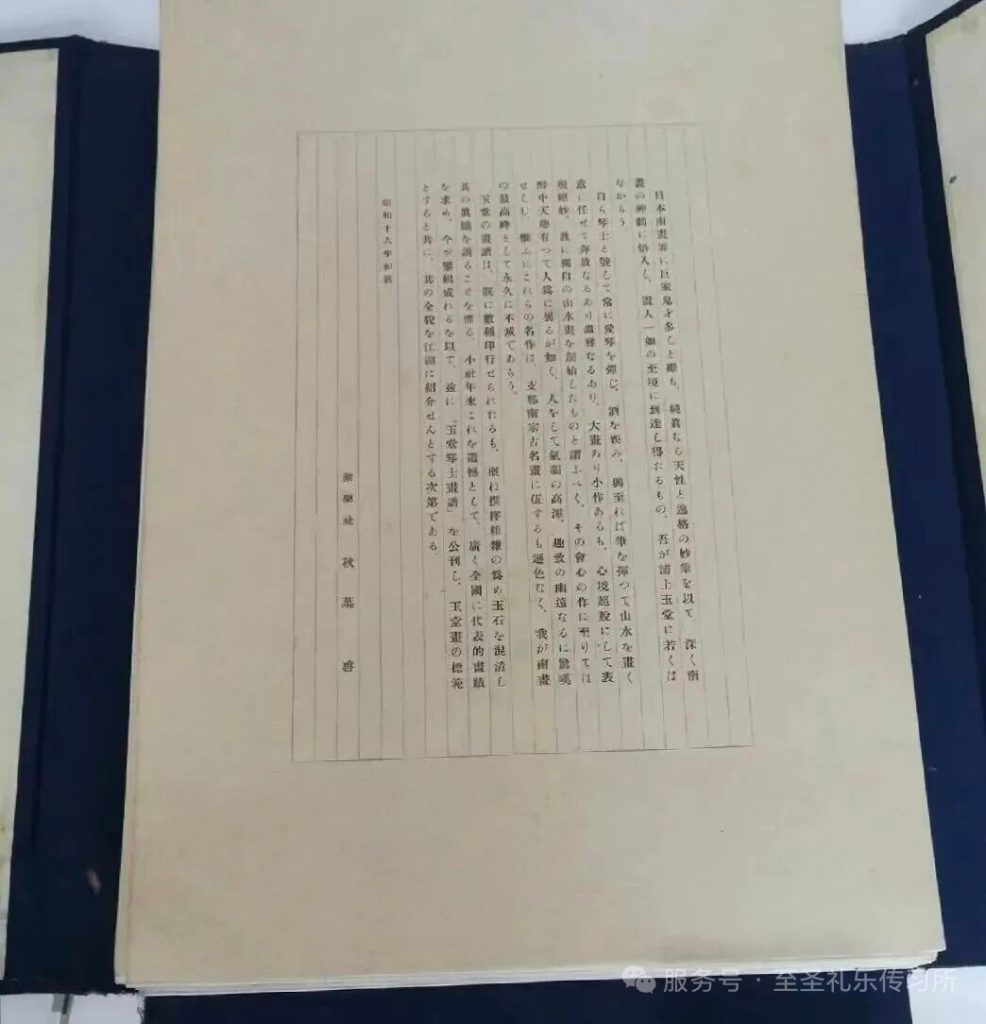
In the middle and late Edo period, Uragami Gyokudō (1745–1820), the third-generation inheritor of the Donggao Qin School, accomplished a crucial step in the localization of the guqin—the compilation of the Gyokudō Qinpu (Gyokudō’s Qin Tablature). This work is Japan’s first specialized qin score that incorporates indigenous musical elements. Its innovations can be clearly demonstrated through a comparative analysis with traditional Chinese qin tablature:
| Dimension of Comparison | Traditional Chinese Qin Tablature (exemplified by the Songxianguan Qinpu) | The Japanese Gyokudō Qinpu |
| Source of Repertoire | Mostly drawn from Chinese historical stories, poetry, and natural imagery (e.g., Xiaoxiang Shuiyun [Mists and Waters of the Xiaoxiang], Meihua Sannong [Three Variations of the Plum Blossom]) | Incorporates Japanese traditional saibara (court banquet music) (e.g., Sakura [Cherry Blossoms], Ranjōō [Prince Lanling]), adapting waka melodies into qin pieces |
| Notation Method | Pure jianzipu (abbreviated character tablature), recording only fingering and string positions, relying on oral transmission for rhythmic supplementation | Jianzipu plus Japanese annotations, marking “sliding pitch range” and “tempo variations,” lowering the learning threshold |
| Performing Techniques | Emphasizes “clear and transparent harmonics” and “full-bodied stopped tones,” pursuing the overall aesthetic of “moderation, balance, and harmony” | Retains core techniques while adding “shallow slides” and “light vibrato,” highlighting the delicate nuances of Japanese music |
| Cultural Connotations | Associated with the Confucian idea that “the gentleman compares his virtue to jade,” emphasizing the qin as “the instrument of the gentleman” | Integrates the samurai spirit of “endurance and forbearance,” advocating that “the qin is a mirror of the mind,” with greater emphasis on personal emotional expression |
The publication of the Gyokudō Qinpu marked the transformation of the guqin from a “reproduction of Chinese art” into an “expression of Japanese culture.” Pieces included in it, such as Haru no Umi (Spring Sea) and Aki no Tsuki (Autumn Moon), remain classics in Japanese qin concerts to this day, and stand as a landmark achievement of localization.
(III) Modern and Contemporary Period: Adaptation Under the Impact of Western Culture
After the Meiji Restoration, Western music was introduced to Japan, and the guqin faced the challenge of “marginalization.” However, its inheritors pursued two pathways to achieve adaptation:
· The “Traditional Preservation” Pathway: Represented by the Nihon Kindō Kyōkai (Japan Qin Way Association, founded in 1929), this approach adheres to traditional repertoire and techniques, regularly holding “Ancient Music Concerts” to sustain the cultural roots of the guqin;
· The “Innovative Integration” Pathway: Some qin players attempted to combine the guqin with modern music. For example, in the mid-20th century, the qin player Yoshida Kiyoshi, in his work Kokyū (The Forbidden City), blended the guqin with electronic music and symphony, bringing the instrument into the field of film and television scoring and thereby expanding its audience.
III. Contemporary Inheritance: Current Status, Challenges, and the Future
Entering the 21st century, although the guqin has not become a mainstream art form in Japan, it still maintains a stable inheritance ecosystem. Its current status can be summarized as “niche yet refined,” while simultaneously facing both opportunities and challenges.
(I) Contemporary Inheritance Ecosystem
- Associations and Activities: In cities such as Tokyo, Kyoto, and Osaka, more than 20 associations are active, including the Tokyo Qin Society and the Kyoto Guqin Association. They regularly hold “monthly elegant gatherings” and “annual concerts,” such as the annual spring “Donggao Qin School Heritage Exhibition,” which attracts qin players from both China and Japan;
- Educational System: Some institutions have incorporated the guqin into their curricula. For example, Tokyo University of the Arts offers “Studies on Traditional East Asian Musical Instruments” (including a guqin concentration), and Kyoto University of Arts and Design offers “Guqin Interest Classes,” cultivating both professional talents and enthusiasts;
- Cultural Exchange: There is frequent interaction between the Chinese and Japanese guqin communities, through events such as the “China-Japan Guqin Dialogue” and the “Donggao Xinyue Cultural Festival.” These activities promote mutual learning in repertoire and exchange of techniques, making the guqin an important bridge in Sino-Japanese cultural exchange.
(II) Challenges Faced
· Transmission Gap: Learning the guqin requires a long period of time (5 to 10 years to achieve proficient performance), and younger generations tend to prefer fragmented forms of entertainment. As a result, practitioners under the age of 30 account for only 15% of the total number of learners (according to the 2023 Report on the Inheritance of the Guqin in Japan);
· Production Difficulties: There are fewer than 10 native guqin makers in Japan, most of whom are over 70 years old. Raw materials (such as paulownia wood and silk strings) rely on imports, leading to high prices for the instrument (entry-level qin cost around 200,000 yen, while professional-grade ones exceed 1,000,000 yen), which restricts its popularization;
· Cognitive Bias: Some members of the public directly associate the guqin with “traditional Chinese culture” without recognizing it as a “local art form,” which affects the breadth of its dissemination.
(III) Future Development Pathways
In response to the above challenges, the Japanese guqin community has already begun exploring preliminary solutions:
· Technology Empowerment: Developing “digital guqin teaching systems” that use AR technology to simulate fingering, thereby lowering the learning curve; utilizing online platforms to host “cloud elegant gatherings” (cloud yaji) to expand audience reach;
· Cross-Border Integration: Collaborating with anime and gaming industries—for example, incorporating guqin music into the Japanese version of Genshin Impact—to attract the attention of younger demographics;
· Cultural Repositioning: Emphasizing the “uniqueness of the Japanese guqin” through exhibitions and lectures. For instance, the Tokyo National Museum once held a special exhibition titled “From Donggao Xinyue to Uragami Gyokudō: The Formation of the Japanese Guqin,” which served to strengthen local cultural identity.
IV. Epilogue: Lessons from Cultural Spillover
As a form of ideology, music is inevitably influenced by political trends and moral concepts. Therefore, it is bound to have intricate connections with politics, rites, and society. Emphasizing these relationships is not in itself objectionable.However, if this relationship is regarded as the very foundation of musical creation, and music is treated merely as a means of statecraft and practical governance while its aesthetic and artistic value is neglected, then music becomes alienated and degenerates into a tool for achieving utilitarian ends. The Confucian proposition that “the qin is that which restrains” (qin zhe, jin ye) was precisely intended to accentuate the non-artistic functions of the guqin, thereby imposing numerous prohibitions on its aesthetic appreciation and stylistic expression.
The journey of the dissemination of Chinese guqin art in Japan is a quintessential case study of “cultural spillover—local adaptation—innovative regeneration” within the Confucian cultural sphere. From “official introduction” in the Nara period, to “school formation” in the Edo period, and then to “cross-border inheritance” in the contemporary era, the guqin is not merely a musical form but a “living fossil” of East Asian cultural exchange.
This process reveals a core principle of cultural dissemination: a culture with genuine vitality does not rely on one-way “export,” but on two-way “dialogue.” The Chinese guqin provided Japan with an artistic vehicle, while Japan, through its localization efforts, infused the guqin with new vitality. In the context of globalization, this model of exchange—characterized by “harmony in diversity”—offers important historical insights for the preservation and development of cultural diversity in today’s world.
Kong Jun
A native of Qufu, Shandong — the hometown of Confucius — Kong Jun is a 76th-generation descendant of the Confucius lineage, the rightful heir to the tradition of Kong Family ceremonial music, and the founder of the artistic exchange team dedicated to the Kong Family guqin tradition and the authentic sounds of classical ceremonial music.
She currently serves as Instructor at the Zhisheng Ritual and Music Transmission Institute of the Qufu Confucius Academy, Secretary-General of the Confucius Artists Association, Council Member of the Jining Guqin Society, Founder of Xiaoshao Guqin Studio, and Instructor at the Confucius Guqin Cultural Exchange Center. She also holds the concurrent position of Deputy Director of the Qufu Poetry, Ritual, and Ceremonial Music Troupe. Kong Jun stands as a leading figure in the living transmission of China’s Kong Family qin scholarship and ancient classical ritual music.
Immersed since childhood in the ritual and musical heritage of Que Li — the sacred birthplace of Confucius — Kong Jun has inherited the profound foundations of the Kong Family tradition of qin music. She has devoted herself to intensive study of such rare and canonical works of Kong Family qin scholarship and musical temperament as the Dacheng Yuelü Quanshu (Complete Compendium of Great Achievement Music and Temperament) and the Qinyuan Xinchuan Quanbian (Complete Transmission of the Qin Garden). Through years of dedicated effort, she has focused on the textual research, restoration, recomposition, and performance of long-lost Kong Family guqin compositions and chapters of the Great Achievement Ceremonial Music. She has accurately revived the ancient playing techniques of the Kong Family guqin and the balanced tonal principles of classical ceremonial music, fully preserving the orthodox lineage of Kong Family qin music and resolving numerous challenges that once threatened the continuity of this ancient musical tradition. Through her work, the authentic sounds of Kong Family qin music, once on the verge of extinction, have been brought back to vibrant life.
For guqin instruction, guqin purchase, traditional Chinese culture study programs, educational tours to the hometown of Confucius, Confucius memorial ceremonies, cultural and artistic exchanges, lectures, and related events, please contact: chinaguqin@outlook.com
Address: Confucius Cultural Park, Dacheng Road, Qufu City, Shandong Province, China.